 |
Where does reality lie?

A film reflex camera

35mm film

The aperture, or diaphragm, together with the ISO and the shutterspeed controls and determines the amount of light that reaches the film.
Elliott Erwitt
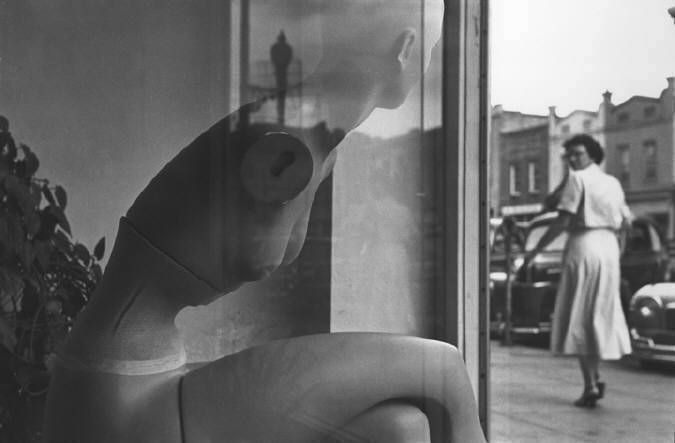
Elliott Erwitt is a French photographer born in 1928 who became particularly famous worldwide after having joined Magnum Photos, the agency founded by Cartier-Bresson, Capa, Seymour, Rodger, and Vandivert in 1947. His photographs are distinctive for their irony, even though much deeper contents are often present, too. A perfect example is the photo above, which is one of my favourites of his.
David Seymour

This is a photograph taken by David Seymour in 1955. The picture represents Bernhard Berenson, an American art collector of Lithuanian origin, looking at Pauline Borghese by Antonio Canova, a Neoclassical sculpture in the Galleria Borghese in Rome. David Seymour was one of the founders of Magnum Photos agency.

This is a photo I took in Summer 2011 during a Jazz Festival in my native village, Atina (FR). The artist on stage was Al Jarreau, a funny but amazing jazz-man, and a great entertainer as well!

The depth of field is "the distance between the nearest and farthest objects in a scene that appear acceptably sharp in an image" (Wikipedia). When taking a photo, the setting of the aperture determines the depth of field of the picture. The more the diaphragm is open, the shallower is the depth of field.

The shutter speed is one of the three fundamental values to consider when taking a photo. It shows how much time the shutter spends to close and open, therefore how much light comes in and, practically, it determines the sharpness of the image's movements and details.
Erich Lessing
 |
| AUSTRIA. 1953. Vienna. At the "Strohkoffer" nightclub, center of Vienna's young artists in the 50's. |

FRANCE. 1951. Paris. Meeting at the Eiffel Tower

HUNGARY. 1956. Magyarovar. Revolutionaries have executed a member of the Communist Secret Police
---
Erich Lessing, who joined Magnum Photos in 1955, took many photos that share almost the same use of lines. Especially in vertical photos, there is always a strongest line that helps the eye to organise the composition of the scene. In Lessing's case, the strongest line is the vertical towards left, that in these photos is created respectively by the backwall (1), the Tour Eiffel (2), and the tree (3).

A photo that I took a few months ago.
What is Color Temperature?
Kelvin is a scale for measuring temperature. The relationship
between color and Kelvin temperature is derived from heating a
"blackbody radiator" (think of this as a piece of black metal) until it
glows. The particular color seen at a specific temperature is the color temperature.
When the blackbody is hot enough and begins to emit light, it is dull
red. As more heat is applied, it glows yellow, and then white, and
ultimately blue.
The numbers of the Kelvin scale are
used when purchasing photographic strobe equipment and film. For
example, the color of the light emitted by a flash is rated at 5500
degrees; it is designed to imitate noon daylight. If the flash produces
light that is 6000 degrees Kelvin, it has a slight bluish tinge. If it
is rated at 4800 degrees, it is slightly warmer, or more yellowish,
than white light.
Ugo Mulas

A photo of Lucio Fontana, 20th century Italian artist, during his work to "Concetto Spaziale"
BASIC PHOTOGRAPHY AS199
John Cabot
University
Prof. Serafino
Amato
Midterm Exam
Fall 2012 Name: Francesca Gallo
______________________________________________________________________________________
Part
I. Technical
Review (40 points)
Suppose your camera has the following settings:
aperture f1.8 f2.8 f4
f5.6 f8 f11
f16 f22
shutter B 1
2 4 8
15 30 60
125 250 500
1000
(It is a manual slr film camera with a 50mm 1:1.8 lens.)
- Which f-stop allows the most light in? f 1.8
- Which allows the least? f22
- Which will give the most depth of field? f 22
- What does depth-of-field mean? the depth of field is the the distance between the nearest and farthest objects in a scene that appear acceptably sharp in an image
- Where is the aperture diaphragm located? It is located inside the lens
- How is aperture measured? The more little is the number, the more open in the diaphragm, so more light comes in and the depth of field is higher
- Which f-stop allows half the amount of light as f5.6? f8
- Which allows twice the light as f5.6? f4
- What does focal length refer to? It is the distance from the lens to the film
- Besides aperture, what is another factor that affects depth of field? the focal length of the lens
- Where is the depth of field scale located (on a traditional slr)? On the lens, close to the diaphragm
- What is the shutter and what does it control? The shutter is a device that closes at different times according to the value set. It controls, together with the aperture, the light coming in.
- How is shutter speed measured? It is measured in numbers that correspond to precise values of time, from 1 second to 1/1000 second
- Where is the shutter located? Inside the camera, behind the lens
- What kind of shutter speed is needed in low light conditions? A low shutter speed
- What does “B” refer to?"B" is the bulb that keeps the shutter open until it is pressed again
- What is the safest slow shutter speed without a tripod? 1/30 second
- Which ss allows twice as much light as “60”(1/60)? 1/30
- Which allows half as much light as “60”? 1/125
- (4 points) On a given day, your camera gives you a correct reading of f4 at 250. What other configurations would give you the same amount of light and a greater depth of field? (list four ways). 1) f 5.6 ss 1/125 2) f 8 ss 1/60 3) f11 ss 1/30 4) f 16 ss 1/15
- Which would give you the same amount (as above) of light and allow you to create a blurred picture of a speeding car? ss 1/60 f8
- Which shutter speed would give you the same amount of light (as above, question 20) at f2.8? f 1/500
- On a shadowy area with a bright sky, how would you insure a correct exposure of a subject in shadow? f 11 ss 1/250
- (4 p)Which is a better setting, f4 at 1/60, or f 16 at 1/4 ? Say why. F4 at 1/60 because this way you have a sharp image, otherwise the shutter speed would be too low and the picture would come out blurry
- What does ISO refer to? It refers to the sensitivity of the film
- What is a fast film and when should it be used? It is a highly sensitive film that should be used when you want grainy photos.
- What is the major problem with fast films? That there is a lot of noise in the picture
- What are the three chemical steps used in printing a photograph? 2 minutes in the developer, 30 seconds in the water, 3 minutes in the fixer
- List two (2 p) ways exposure is controlled in the darkroom. 1) strength of the red light (diaphragm stops) 2) the amount of time set
- How is contrast manipulated in the darkroom? The contrast changes according to the filter used in the enlarger.

No comments:
Post a Comment