Julia Martin

I took this picture on top of House Mountain in Lexington, VA during Fall 2012.


35mm film
Aperture: Simply put, aperture is a hole within a lens, through which light travels into the camera body. The iris of the lens that controls the size (diameter) of the aperture
is called “diaphragm” in optics. The sole purpose of the diaphragm is to
block or stop all light, with the exception of the light that goes
through the aperture. In photography, aperture is expressed in f-numbers
(for example f/5.6). These f-numbers that are known as “f-stops” are a
way of describing the size of the aperture, or how open or closed the
aperture is. A smaller f-stop means a larger aperture, while a larger
f-stop means a smaller aperture. Most people find this awkward, since we
are used to having larger numbers represent larger values, but not in
this case. For example, f/1.4 is larger than f/2.0 and much larger than
f/8.0.


Depth of Field:
Depth of field is one of many basic film photography tips to heighten the look of a photograph. In short, it is the distance between the foreground and background of the subject that appears to be in focus. There are two types of depth of field – shallow and great. Shallow depth of field involves one point of focus with the foreground and/or background blurred. Conversely, great (maximum) depth of field puts nearly everything in focus. Change in depth of field is not an immediate transition between sharp to unsharp. Instead, there is a gradual transition of sharpness to fuzziness to totally out of focus areas. With aperture settings, the larger the aperture opening (smaller f-stop numbers) and closer the focal distance, the shallower the depth of field will result. On the other hand, small aperture openings (larger f-stop numbers) and farther focal distances will equate to a greater depth of field.

Photo by Bruno Barbey, taken in 1964, Rome, Italy. This photo demonstrates shallow depth of field.

This is an image that I found on Magnum's website taken by David Seymour in Vienna, Austria, 1949. I like this photo because I like the sense of motion given by the blurred dresses, as well as the contrast between the well-lit dancers and the dark tables. I'm assuming the blurred effect was created using a slow shutter speed.
James Natchway
Natchway is an American photojournalist and war photographer.


![[india+1993.jpg]](https://blogger.googleusercontent.com/img/b/R29vZ2xl/AVvXsEhDX0lF1oqhW5-ise-Pi_6_VUNlda-fNDPNb3aLI3HKCLkLueI_2EgYZaTXVJUlbXGZ0Vnnbqln_7U2Rvofpoe7jq8yPOeF8JYnoC_b1DQQWIxox4Yr3JJOe7RM7QKD4ziA7h6-dW9YGeOm/s1600/india+1993.jpg)
James Nachtwey documentary, War Photographer
When used in photography, Kelvin temperature is a scale that measures the relative warmth or coolness in a given scene: how yellow/red or green/blue, for instance, the light is that you’re shooting in.Notice how lower temperatures are very warm, and following the color spectrum, increase in numeric value as they become cooler. So a sunset scene might show up on this scale as 1000-2000 K, while a cloudy day comes in at 7000 K. Interestingly to me, look at how open shade/skylight-type lighting taps out so much bluer at a full 10,000 K.


James Natchway
Natchway is an American photojournalist and war photographer.
"I
have been a witness, and these pictures are
my testimony. The events I have recorded should
not be forgotten and must not be repeated."
Afghanistan, 1996 - Ruins
of Kabul from civil war.
Czechoslovakia,
1990 - Heavy metals contaminated the air of an aluminum factory.
Bosnia,
1993 - Ethnic cleansing in Mostar. Croat militiaman fires on his Moslem
neighbors.
Alabama,
1994 - Prisoner on the chain gang.

Kosovo,
1999 - Deportees returned during harvest time.
Photographic printing is the process of producing a final image on paper for viewing, using chemically sensitized paper. The paper is exposed to a photographic negative, a positive transparency (or slide), or a digital image file projected using an enlarger or digital exposure unit such as a LightJet printer. Alternatively, the negative or transparency may be placed atop the paper and directly exposed, creating a contact print.
The process consists of four major steps, performed in a photographic darkroom or within an automated photo printing machine. These steps are:
- Exposure of the image onto the sensitized paper using a contact printer or enlarger;
- Processing of the latent image using the following chemical process:
- Development of the exposed image reduces the silver halide in the latent image to metallic silver;
- Stopping development by neutralizing, diluting or removing the developing chemicals;
- Fixing the image by dissolving undeveloped silver halide from the light-sensitive emulsion:
- Washing thoroughly to remove processing chemicals protects the finished print from fading and deterioration
 |
| Carnivale in Venice in San Marco Square (02/09/13). |
 |
| Carnivale in Venice in San Marco Square (02/09/13). |
 |
| I took this picture along the Grand Canal in Venice on 02/09/13. |
 |
| I took this picture near the Pantheon during the 3rd week. |
James Nachtwey documentary, War Photographer
When used in photography, Kelvin temperature is a scale that measures the relative warmth or coolness in a given scene: how yellow/red or green/blue, for instance, the light is that you’re shooting in.Notice how lower temperatures are very warm, and following the color spectrum, increase in numeric value as they become cooler. So a sunset scene might show up on this scale as 1000-2000 K, while a cloudy day comes in at 7000 K. Interestingly to me, look at how open shade/skylight-type lighting taps out so much bluer at a full 10,000 K.
The Kelvin scale shows the full range of the color spectrum.
Ferdinando Scianna
ITALY. 1981. Sicily. Bagheria. Old woman back of the shutters.
BASIC PHOTOGRAPHY AS199
John Cabot University
Prof. Serafino Amato
Midterm Exam
Fall 2012 Name: Julia Martin
______________________________________________________________________________________
Part I. Technical
Review (40 points)
Suppose your
camera has the following settings:
aperture f1.8
f2.8 f4 f5.6 f8 f11 f16 f22
shutter B 1
2 4 8 15 30 60 125 250 500 1000
(It is a
manual slr film camera with a 50mm 1:1.8 lens.)
1.
Which f-stop allows the most light in? F1.8
2.
Which allows the least? F22
3.
Which will give the most depth of field? F22
4.
What does depth-of-field mean? The distance
between the nearest and farthest objects in a shot that are in focus.
5.
Where is the aperture diaphragm located? In the lens
of the camera.
6.
How is aperture measured? In F-stops
7.
Which f-stop allows half the amount of light as f5.6?
f8
8.
Which allows twice the light as f5.6? f4
9.
What does focal length refer to? The distance
between the lens and the image it forms on the film. Determines the angle of
view, or how much a lens “sees”
10. Besides
aperture, what is another factor that affects depth of field? Focal length
11. Where is the
depth of field scale located (on a traditional slr)? The f-stop settings
are located on the lens at the ring closest to the photographer
12. What is the shutter
and what does it control? A device that allows light to pass through an
image to film for a determined amount of time to develop the image. It controls
the exposure of the photo.
13. How is
shutter speed measured? Exposure values (EVs)
14. Where is the
shutter located? Between the diaphragm and the film.
15. What kind of
shutter speed is needed in low light conditions? Slow (ie 1, 2, 4, 8)
16. What does
“B” refer to? Bulb, it is the shutter speed setting that allows the shutter to
remain open only so long as the shutter release is held down.
17. What is the
safest slow shutter speed without a tripod? 60
18. Which ss
allows twice as much light as “60”(1/60)? 30
19. Which allows
half as much light as “60”? 125
20. (4 points)
On a given day, your camera gives you a correct reading of f4 at 250.
What other configurations would give you the same amount of light and a greater
depth of field? (list four ways).
F5.6 at 125. F8 at 60. F11 at 30. F16 at 15.
21. Which would
give you the same amount (as above) of light and allow you to create a blurred
picture of a speeding car? F16 at 15.
22. Which
shutter speed would give you the same amount of light (as above, question 20)
at f2.8? 500
23. On a shadowy
area with a bright sky, how would you insure a correct exposure of a subject in
shadow? Adjust your aperture a stop or two higher than the light meter
instructs.
24. (4 p)Which
is a better setting, f4 at 1/60, or f 16 at 1/4 ? Say why. F4 at
1/60 because the shutter speed is faster so the image will be sharper.
25. What does
ISO refer to? The film sensitivity to light.
26. What is a
fast film and when should it be used? Fast film is film that is more sesnsitive
to light so needs less light to expose it. It should be used indoors or when
you’re in an area with less light.
27. What is the
major problem with fast films? The faster the film, the more grainy the images.
28. What are the
three chemical steps used in printing a photograph? Developing, stopping,
fixing
29. List two (2
p) ways exposure is controlled in the darkroom. The amount of time the
image is printed by the enlarger onto the print. The amount of time the print
is left in the developer.
30. How is
contrast manipulated in the darkroom? Filters (0 for low contrast; 5 for high
contrast)
Technical Comments:

This photo was likely taken with a 35 mm camera with a normal lens or telephoto lens (flat perspective) and low iso. It appears that the picture was taken either during the morning or the afternoon, judging by the natural light. The photography was likely at ground level using a lens designed for architecture and a tripod (straight lines of the buildings) given the angle of perspective.

This photo was likely taken with a 35 mm camera with a moderate wide angle lens given the depth and high iso. The photo was probably taken with around a 5.6 diaphragm. The photo is slightly underexposed. The lighting is all artificial with no flash. The photography was likely squatting given the angle of perspective.

This photo was likely taken with a 35 mm camera using natural light on a sunny day with no flash, with low iso using a moderate wide angle lens. The photo is slightly overexposed. The photography was probably standing.

This photo was likely taken with a 35 mm camera using natural light on a cloudy/cast over day with no flash. Medium iso using a normal lens. The photo is perfectly exposed. Given the perspective, the photographer was probably slightly above the crowd looking somewhat down on the cow. The diaphragm is not closed, around 8 diaphragm. By looking at how clean the whites of the photo are and the time the photo was taken (1970), we can guess that the photographer used trichromatic film.

This photo was likely taken with a 35 mm camera using natural light on a sunny day with no flash some time in the morning or afternoon (given the length of the shadows). The photo is well exposed. The diaphragm was likely around 11. The photographer was likely standing looking at eye-level with the subject. It appears to be medium iso using a normal lens.
Photographic Film


Technical Comments:

This photo was likely taken with a 35 mm camera with a normal lens or telephoto lens (flat perspective) and low iso. It appears that the picture was taken either during the morning or the afternoon, judging by the natural light. The photography was likely at ground level using a lens designed for architecture and a tripod (straight lines of the buildings) given the angle of perspective.

This photo was likely taken with a 35 mm camera with a moderate wide angle lens given the depth and high iso. The photo was probably taken with around a 5.6 diaphragm. The photo is slightly underexposed. The lighting is all artificial with no flash. The photography was likely squatting given the angle of perspective.

This photo was likely taken with a 35 mm camera using natural light on a sunny day with no flash, with low iso using a moderate wide angle lens. The photo is slightly overexposed. The photography was probably standing.

This photo was likely taken with a 35 mm camera using natural light on a cloudy/cast over day with no flash. Medium iso using a normal lens. The photo is perfectly exposed. Given the perspective, the photographer was probably slightly above the crowd looking somewhat down on the cow. The diaphragm is not closed, around 8 diaphragm. By looking at how clean the whites of the photo are and the time the photo was taken (1970), we can guess that the photographer used trichromatic film.

This photo was likely taken with a 35 mm camera using natural light on a sunny day with no flash some time in the morning or afternoon (given the length of the shadows). The photo is well exposed. The diaphragm was likely around 11. The photographer was likely standing looking at eye-level with the subject. It appears to be medium iso using a normal lens.
Photographic Film
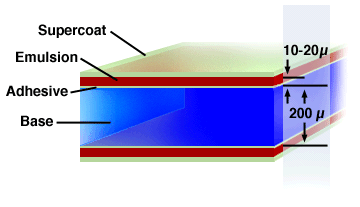
The supporting layer in film is called the base. This base has to be transparent (with some optical density), free
from imperfections, chemically stable, insensitive photographically, and resistant to moisture and processing
chemicals, while remaining mechanically strong, resistant to tearing, flexible, and dimensionally stable.
The most fundamental layer in a film is the emulsion layer(s), adhered to the base by means of a binder. The emulsion is the photographic part of the film, and as noted from ANSI, “consists of dispersions of light-sensitive materials in a colloidal medium, usually gelatin, carried as a thin layer(s) on a film base.” Emulsion is made by dissolving silver bullion in nitric acid to form silver-nitrate crystals. These crystals are dissolved and mixed with other chemicals to form silver-halide grains, and then suspended in the gelatin emulsion coating. The size and degree of light sensitivity of these grains determines the speed or amount of light required to register an image. The faster the film, the greater the apparent “graininess” of the image.
The subbing layer is applied to the film base so that the emulsion adheres to the base.
Although we can’t see ultraviolet (UV) radiation, photosensitive silver halide crystals can be exposed by it. An ultraviolet absorbing layer is included to protect the imaging layers from exposure by UV radiation.
The top layer of the film is the supercoat. The purpose of this clear layer of hardened gelatin is to protect the emulsion from damage during transport through the camera.
Light penetrating the emulsion of a film can reflect from the base-emulsion interface back into the emulsion,
causing a secondary exposure around images of bright objects. This secondary image (halation) causes an
undesirable reduction in the sharpness of the image and some light scattering. An antihalation layer, a dark
coating on or in the film base, will absorb and minimize this reflection.
The most fundamental layer in a film is the emulsion layer(s), adhered to the base by means of a binder. The emulsion is the photographic part of the film, and as noted from ANSI, “consists of dispersions of light-sensitive materials in a colloidal medium, usually gelatin, carried as a thin layer(s) on a film base.” Emulsion is made by dissolving silver bullion in nitric acid to form silver-nitrate crystals. These crystals are dissolved and mixed with other chemicals to form silver-halide grains, and then suspended in the gelatin emulsion coating. The size and degree of light sensitivity of these grains determines the speed or amount of light required to register an image. The faster the film, the greater the apparent “graininess” of the image.
The subbing layer is applied to the film base so that the emulsion adheres to the base.
Although we can’t see ultraviolet (UV) radiation, photosensitive silver halide crystals can be exposed by it. An ultraviolet absorbing layer is included to protect the imaging layers from exposure by UV radiation.
The top layer of the film is the supercoat. The purpose of this clear layer of hardened gelatin is to protect the emulsion from damage during transport through the camera.
Finally, film may have what’s called an anti-halation layer.
-
HOW IMAGES ARE FORMED ON FILM
The most vital components of film are the silver halide crystals. During camera or printer exposure to light, photons are absorbed by the silver halide crystals and form a “latent” or hidden image. The latent images are not visible to the human eye. They become visible during processing.
The latent image consists of a cluster of a minimum of four metallic silver atoms in the silver halide crystal structure. The presence of these silver atoms makes the whole crystal capable of being developed. Without them, the crystal will not develop.
Chemical development of the exposed crystals converts them to 100% silver, providing a huge amplification of the latent image.
In order to differentiate between tones of deep shadows all the way to bright highlights in the film image, various sizes of silver halide crystals are used. The smallest are the least sensitive and can only record the brightest highlights. The largest crystals are the most sensitive and can record the deepest shadows.

Bernd/Hilla Becker – German collaborative duo known for their work of industrial buildings
and structures. I enjoy their work because they take objects that are usually
overlooked, ie forgotten industrial buildings, and present them in such a way
that they become interesting. On their own, the objects may appear boring or
normal. But presenting them in a repeating pattern draws out the strangeness in
the objects and the complexities of the structures. I also enjoy how these
photographs have a series of lines, creating a pattern within themselves.
Used 8 x 10 inch
view camera. The photographer was likely using a tripod, but the view camera
permitted him to gain the perspective of viewing these objects at their height
rather than below. The depth of film is great. Low iso given the low level of
grain. Probably a smaller aperture with a slow shutter speed. The photos were
taken on cloudy days probably in the early morning. The exposure is average.


No comments:
Post a Comment